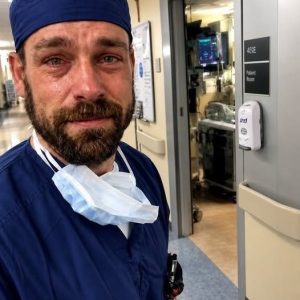
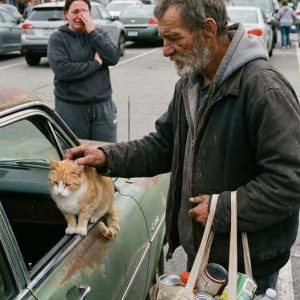
The subway car felt tense the moment he boarded, a heavy quiet settling under the flickering lights as commuters subtly shifted away. He was big, tattooed, wrapped in worn black leather, the kind of man people instinctively read as dangerous. But what unsettled them wasn’t his size. It was the fact that he was crying.
I stayed where I was, unable to look away—not because of fear, but because of the tenderness in his hands. He wasn’t just holding the dog; he was sheltering it. The animal’s breathing was shallow, uneven, its gray-flecked fur dulled by age and illness. Every so often, its tail gave the faintest tap against his sleeve, a last reflex of loyalty. Someone muttered about calling security, but the biker didn’t react. He leaned close, whispering promises he clearly couldn’t keep, except one—that he wouldn’t let go.
“He looks like a good friend,” I said softly. The man finally lifted his eyes, red and exhausted. “The best,” he replied. He told me the dog’s name was Buster, that cancer had taken over, and that he refused to say goodbye in a sterile clinic. They were going to Coney Island instead. Years earlier, he had found Buster shivering under the boardwalk after returning from war, broken and angry, barely holding himself together.
As the train rattled toward the coast, something shifted. The fear drained from the car. A teenager removed his headphones and watched quietly. An older woman passed forward a tissue without a word.Strangers stood together in silence, bearing witness. When we finally dispersed, the city felt different. We had boarded guarded and distant, but left reminded that compassion dissolves fear the moment someone chooses to step closer instead of away.