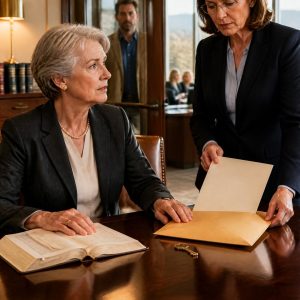
“No,” Daniel said into the phone. “She cannot be in San Francisco.”
He listened again.
Then his expression drained of color.
“What do you mean, she already signed?”
Nobody moved.
The November wind pushed a scatter of brown leaves across my front walk. Behind the windows, the dining room waited in its ordinary silence, the chairs still where I had left them, the family photographs standing proudly on the sideboard, and the place where the red bowl usually sat empty.Daniel looked at the envelope in his hand as if it had become something alive.
Rebecca stared at him. “What did she sign?”
He did not answer.
“Daniel,” she said, louder this time. “What did she sign?”
His phone remained pressed to his ear. My attorney was speaking, but the people outside could hear only the occasional change in Daniel’s breathing.
Finally, he said, “I did not force anything.”
The voice on the phone must have answered sharply, because Daniel pulled the phone away from his ear and looked at the screen.Mrs. Carter folded her arms. “Nobody said you forced anything.”
“You are all acting like I did something wrong.”
Lily, his daughter, stood several feet behind him with a dish of dinner rolls balanced against her hip. She looked from her father to the document he had brought, then toward the locked front door.
“Dad,” she said, “what is that paper?”
“It is a planning document.”
“You said Grandma was going to sign it today.”
“She was going to review it.”For the first time in forty years, I had no Thanksgiving guests to feed, no document to sign, no family expectation waiting at the door.
I had a home.
I had my name.
And I had finally learned that the safest place in the world was not the house I had spent my life protecting.
It was the moment I stopped letting anyone else decide what I was allowed to keep.