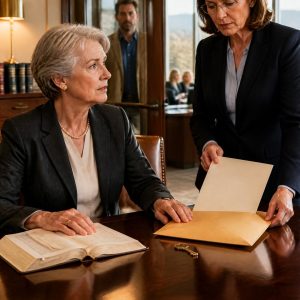
The caller identification showed Ethan.
I answered, but neither of us spoke.
Then he whispered, “Claire, you have to get to the storage unit before my mother does.”
I looked through the glass wall of my office at Diane standing beside the dark sedan below. The late afternoon sun turned the windows of the buildings across Elm Street into sheets of fire. She remained perfectly still, her phone pressed to her ear.
“She is outside,” I said.
“I know.”
“How?”
“Because she called me two minutes ago and asked whether you had opened the envelope.”
My fingers tightened around the receiver. “What exactly did you put in Box 214?”
“Not what she thinks.”
“That is not an answer.”
“I could not say anything at the courthouse. She had people watching us.”
The word made me glance toward the hallway. My assistant, Nora, was sorting correspondence at the front desk. Beyond her, two clients waited in the reception area with their coats folded over their knees. No one looked suspicious. No one looked like a person Diane might have hired.
But three months earlier, I would have dismissed such caution as paranoia.
Three months earlier, I had still believed Ethan was merely weak.
Now I understood that weakness could be more dangerous than cruelty because it kept changing shape. It could look like regret, fear, helplessness, or love, depending on what the person needed from you.
“Tell me why I should trust you,” I said.
“I do not expect you to trust me.”
“Good.”
“I expect you to look at the evidence.”Diane had taken almost everything she could carry.
Ethan had helped her.
But neither of them understood the truth until it was too late.
They had not left me with nothing.
They had left me with the one thing their lies could not survive:
the record of what they had done.