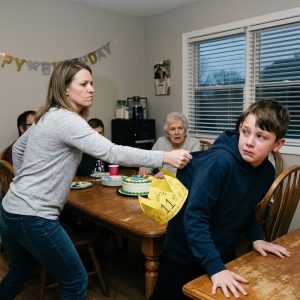
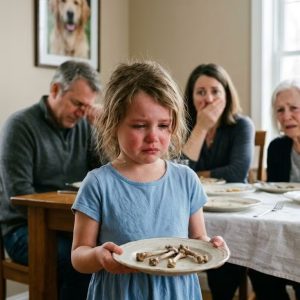
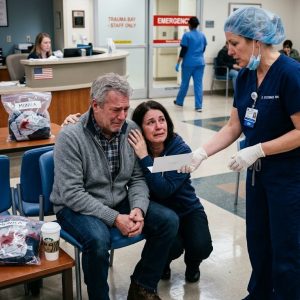
The days after I left the hospital felt unreal in a way I couldn’t explain to anyone who hadn’t experienced their own body turning against them in public. People kept calling it an “incident,” a “scare,” a “misunderstanding that went too far,” as if language could soften the reality of what had happened at that kitchen table. But there was nothing soft about it. I remember waking up each morning and checking my throat before I even opened my eyes fully, testing for tightness, testing for betrayal inside my own immune system. The world looked unchanged—sunlight through the curtains, the hum of the refrigerator, Marcus texting to ask if I needed anything—but I was different in a way that didn’t announce itself visually. Sabrina’s words echoed in my head more than the reaction itself: I wanted to prove you’re faking it. That sentence didn’t just describe ignorance. It described intention. It described someone looking at another person’s vulnerability and deciding it was a challenge to be tested rather than a boundary to be respected. And that realization, more than the peanuts, more than the ambulance, was what made it impossible for me to ever feel safe around her again.
When the legal process began, it unfolded with a strange mix of urgency and bureaucracy that felt disconnected from what had actually happened to my body. Officers took statements, paramedics submitted reports, and the kitchen container I had handed over became evidence sealed in plastic as if it belonged to a world separate from my fear. Sabrina’s version arrived almost immediately through her lawyer: she hadn’t believed me, she hadn’t intended harm, she had been “provoked by ongoing conflict about the wedding.” That framing angered me in a way I didn’t expect—not because it was false in every detail, but because it treated disbelief as neutral. As if choosing not to believe someone about a life-threatening condition was just a personality flaw instead of a risk factor. Marcus gave his statement calmly, repeating exactly what he had heard, while my mother sat beside me in every hearing like a physical reminder that I still belonged to someone in a world where I had almost been erased. My sister Paige, on the other hand, was less restrained. She called it what it was without hesitation: an act of reckless endangerment born from arrogance. Watching Sabrina’s family try to soften it—calling it stress, calling it panic, calling it “a mistake that got out of hand”—made me realize how often people protect the idea of someone instead of the consequences of what that person did.
But the most difficult part was not the courtroom or the police reports—it was the emotional disassembly of what I thought our relationship had been. I kept replaying the months before the dinner, searching for moments that should have warned me more clearly, as if hindsight could absolve me of not seeing what I wasn’t yet willing to believe. There had been subtle dismissals, jokes about my “extreme caution,” frustration whenever I insisted on reading labels or confirming ingredients. At the time, I told myself it was just incompatibility, just stress, just the way people behave when they are overwhelmed by wedding planning. But in retrospect, those were not isolated annoyances. They were steps in a pattern where my safety was slowly reframed as inconvenience, where my medical reality was treated like a negotiable preference. That is what made the moment at the table so devastating in retrospect—it wasn’t spontaneous. It was consistent with everything that came before it. The dinner was just where disbelief turned into action, and action turned into emergency.
As the case moved forward, I stopped engaging with the idea that everyone would understand it the same way I did. Sabrina’s plea for diversion instead of prosecution came with carefully worded statements about accountability, remorse, and misunderstanding. Her friends messaged me phrases like she didn’t mean it and don’t ruin her life over one mistake, as if the scale of harm could be reduced by intention alone. I remember staring at my phone one night, reading one message in particular that said, It was just a meal. That sentence stayed with me longer than any legal document. Because to me, it had not been “just a meal.” It had been trust made edible. It had been the assumption that someone who knows your body would not gamble with it to win an argument. My lawyer told me I didn’t need to engage with any of it, that silence was also a form of protection. So I learned to let the system speak for me. The charge changed as evidence was reviewed, the language adjusted from emotional accusations to formal legal definitions, but the underlying truth remained unchanged: harm had occurred, risk had been ignored, and consequences followed. Still, even with legal validation, there was a part of me that understood justice was not designed to restore what had been fractured internally.
Recovery became a process of learning how to exist without constant surveillance of my own body. At first, I couldn’t eat anything I didn’t prepare myself. I would sit in Marcus’s apartment holding a sealed container like it was armor rather than food. My senses became hyperaware—smells, textures, even the sound of utensils on ceramic plates could trigger anxiety responses that had nothing to do with actual danger anymore. Therapy helped me name what I was experiencing: not just trauma from the allergic reaction, but betrayal trauma layered on top of it. Because what Sabrina had broken was not only trust in a person, but trust in my right to be believed about my own body. Slowly, I began to rebuild routines that didn’t revolve around fear. I started going to restaurants again, but only ones where I could speak directly to chefs. I learned to sit through meals without scanning every ingredient like evidence in a trial. Marcus never pushed, never rushed, just stayed present in ways that didn’t demand gratitude. My family adapted around me in quiet, practical ways—reading labels together, asking questions without embarrassment, treating my caution as normal rather than excessive. And in that normalization, something began to heal that had nothing to do with Sabrina’s apology or lack of it.