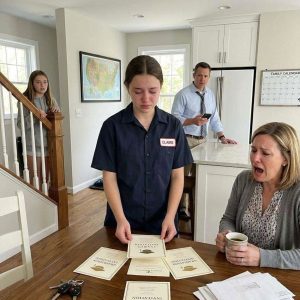
She looked me over from head to toe—barefoot, wearing leggings, hair pulled back, reviewing contractor invoices at the table I had chosen and paid for—and asked in that cool, clipped tone she used whenever she wanted to sound polite while being cruel, “Why are you still here?”
The room went very still.
Outside, rain tapped against the large back windows of the Brentwood house just south of Nashville. Inside, the refrigerator hummed softly, the grandfather clock in the hallway ticked once, and my ex-husband, Trevor Hale, froze halfway down the staircase.
I smiled calmly and set my pen down.
“Because this house was paid for with my money.”
My ex-mother-in-law, Diane Hale, went pale so fast it looked like someone had pulled the color out of her face. Trevor stopped moving entirely.
His younger sister, Vanessa, who had been reaching for a piece of toast, lowered her hand like she had touched something burning hot.
“No,” Diane said immediately, almost by reflex. “That’s not funny.”
“I’m not joking.”
Trevor hurried down the rest of the stairs, gripping the banister. “Megan,” he said sharply, “do not start this.”
I turned my chair to face him.
“You mean now? Or do you mean two years ago, when you begged me to liquidate part of my settlement account so we could beat the cash offer on this place? Or maybe last summer, when your mother kept calling it ‘Trevor’s family home’ at dinner parties?”
Diane’s mouth opened, then closed again.
Trevor’s jaw tightened.
That house—white brick, black shutters, six bedrooms, a pool in the back—the kind of home people bought to prove a point—had been our biggest symbol and our biggest lie. Everyone in his family believed Trevor had purchased it through determination, good timing, and Hale-family success. They loved telling that story.
They repeated it so often that eventually they started believing it themselves.
The down payment—almost all of it—had come from me.
More specifically, it came from the wrongful-death settlement I received after my father was killed by a trucking company driver on Interstate 40. Money I would have returned in a heartbeat if it meant having him alive. Money I kept in a separate account.
Money Trevor once swore he would never touch.
And yet, standing in that kitchen after the divorce, with his mother acting like I was some unwanted guest who had overstayed brunch, I realized they had all convinced themselves of the same convenient fantasy: once the marriage ended, I was supposed to disappear quietly and leave the house behind as if my grief had built it for them.