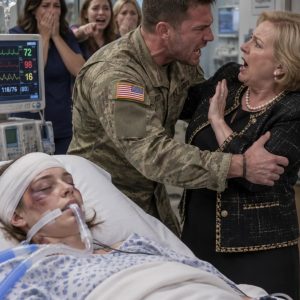
My husband shoved me against the refrigerator, the metal biting into my spine. Before I could even scream, he drove his knee into my face. I heard a crack that didn’t sound human. Blood rushed warm and fast, blurring my vision. I slid to the floor, shaking, my hands instinctively reaching for my phone. I needed help. I needed proof.
That was when Linda, my mother-in-law, lunged forward and ripped the phone from my fingers. “Stop being dramatic,” she snapped, shoving it into her pocket. “It’s just a small scratch.”
A small scratch. I could taste iron. My nose was crooked, swelling by the second. My husband, Mark, paced the kitchen like nothing had happened, rubbing his hands together as if he were the victim. His father, Richard, barely looked up from his chair.
“Drama queen,” he muttered. “You always exaggerate.”
That word followed me everywhere in that house. Drama. Sensitive. Unstable.
I pressed my sleeve to my face, trying to slow the bleeding. My heart hammered louder than the refrigerator’s hum. This wasn’t the first time Mark had hurt me, but it was the first time they’d all watched and decided to protect him.
Linda leaned down, her face inches from mine. “If you call the police,” she whispered, “we’ll make sure everyone knows how crazy you are.”
I believed her. For years, they had chipped away at me, correcting my memories, rewriting arguments, telling friends I was “emotional.” I had started to doubt myself. Even now, part of me wondered if I really was overreacting.If this story resonated with you, share it. Comment your thoughts. Start a conversation someone else might be too afraid to begin.
Because the moment we stop calling survivors “dramatic”
is the moment abusers lose their power.